

















%20-%20Edge%20computing.png?width=264&height=264&name=Glass%20icon%20(dark)%20-%20Edge%20computing.png)
CES 2026: Scaling Physical AI - from Pilot to Fleet
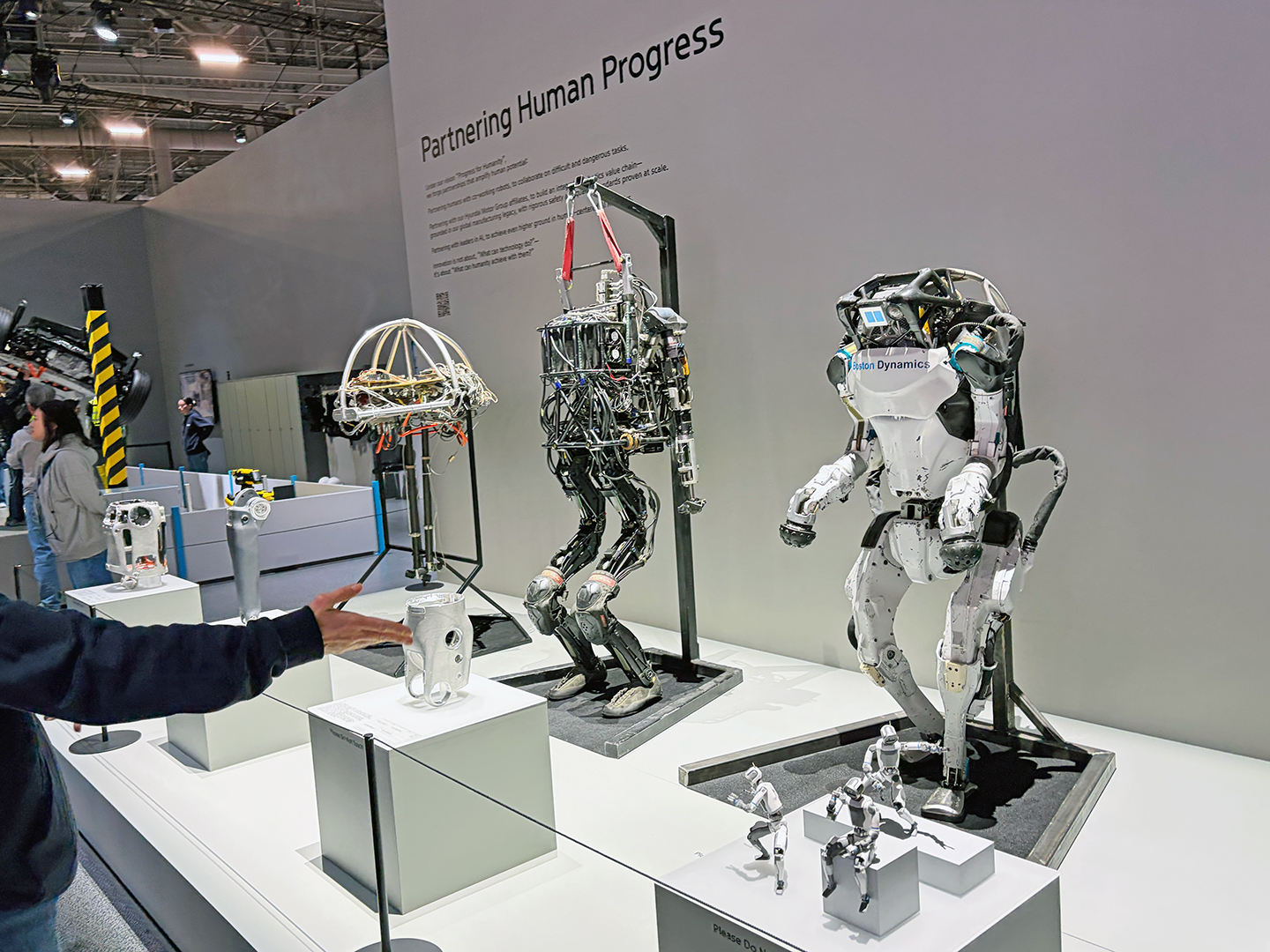
CES 2026 signals a clear shift in physical AI: the conversation is moving beyond what’s possible in a demo to what’s operable in the real world. As fleets grow, the differentiator won’t be the pilot - it will be the operational foundation that makes deployments repeatable, secure, and maintainable.
CES 2026 put physical AI front and center: AI that senses, decides, and acts in the real world through robotics, autonomous machines, and edge-connected systems. The show’s messaging and floor narrative emphasized that the next phase of AI won’t live only in software or the cloud; it will be deployed in physical systems and operated at the edge.
As physical AI leaves prototypes behind and enters factories, logistics networks, utilities, mobility, and retail, the question shifts from:
“Can we build it?”
to
“Can we run it safely, securely, and reliably at scale?”
What CES 2026 underscored is that building physical AI is only half the battle; operating it at scale is the real test.
Physical AI changes the rules of deployment
Traditional AI workloads can often tolerate latency, cloud-dependent control, and occasional interruptions. Physical AI can’t.
When AI controls machines that move, lift, sort, navigate, or interact with people and infrastructure, the operational bar rises sharply. These systems must run continuously, respond instantly, and remain safe even when connectivity is imperfect. Failures don’t just affect data, they interrupt workflows, damage assets, and introduce real-world risk.
When AI controls machines that move, lift, sort, navigate, or interact with people and infrastructure, requirements expand fast:
- Uptime becomes mission-critical: when systems go down, physical work stops
- Low-latency decisions are required: machines can’t wait on cloud round-trips to behave correctly
- Connectivity can’t be assumed: factories, warehouses, and mobile assets often operate with limited or unstable networks
- Security becomes physical safety: breaches can affect people, equipment, and facilities, not just data
- Lifecycle complexity increases: devices run for years across mixed hardware, software, and compliance environments
CES 2026 reinforced that physical AI isn’t “one device.” It’s a distributed fleet, operated across locations, networks, and conditions.
The physical-AI trends that stood out at CES 2026
- Robotics is becoming operational, not demonstrative
CES made it clear that robotics is moving past eye-catching demos toward clearly defined, repeatable tasks in real environments. The focus is shifting from “what’s possible” to “what can run every day,” raising the bar on uptime, safety, and ongoing management once robots leave the show floor and enter production settings. - The physical-AI stack is consolidating around platforms, not components
Rather than assembling AI stacks from disconnected tools, the market is moving toward orchestrated platforms that unify compute, connectivity, security, and lifecycle management into a single system. - Edge-first autonomy is becoming the default operating model
CES themes repeatedly reinforced that physical AI depends on local inference and local control. Real-time behavior, intermittent connectivity, and safety requirements make cloud-only architectures impractical, pushing intelligence and responsibility closer to the edge. - “Physical AI” is now an executive-level category
What was once a niche term is now being used as a strategic umbrella that connects robotics, autonomy, edge compute, and industrial AI. That shift reflects a broader realization: success in physical AI depends as much on operations, governance, and lifecycle control as on models or hardware.
The real challenge: operating physical AI in the wild
When physical AI moves beyond pilots, teams run into the same wall, only faster:
- Distributed fleets spanning sites and networks
- Frequent updates (models, apps, policies, safety constraints)
- Mixed hardware across generations
- Split ownership across IT, OT, engineering, vendors, and integrators
- Security and access controls that must remain consistent everywhere
At that point, the differentiator stops being the successful demo and becomes long-term operability: the ability to provision, secure, update, and monitor systems predictably across time and scale.
Why integrated edge technology stacks are becoming essential
One of the clearest patterns implied by CES 2026’s physical-AI direction: edge systems can’t be operated as fragmented tools.
When connectivity, operating systems, security, observability, and lifecycle management are handled as separate layers, complexity compounds and risk rises, especially as fleets grow.
Integrated stacks reduce that risk by designing deployments to be:
- repeatable across sites
- governable across teams
- maintainable across years
- resilient under imperfect connectivity
That’s what makes physical AI operational in the real world
What this means for organizations adopting physical AI in 2026
If your roadmap includes robotics, autonomous inspection, smart logistics, or AI-driven industrial automation, CES 2026 points to one priority:
Treat operations like part of the product, not an afterthought.
Successful deployments start with the operational foundation that enables teams to:
- onboard and provision devices reliably across sites
- enforce consistent identity and access governance
- run software updates safely (with rollback)
- monitor fleet health in real time
- ensure secure connectivity without single points of failure
- maintain audit-ready traceability and policy compliance
The differentiator won’t be who runs the best pilot. It will be who can operate a reliable fleet.
How CTHINGS.CO Orchestra supports scalable physical AI operations at the edge
Orchestra is built for distributed edge and industrial environments where reliability, security, and scalability are non-negotiable.
For physical AI fleets, that translates into:
- Unified operations: one platform for connectivity, OS management, provisioning, updates, and security, with real-time visibility into fleet health and performance
- Future-proof lifecycle: controlled change and remote updates across long-lived assets
- AI-assisted operations: guided troubleshooting and faster resolution when systems drift
- Enterprise-grade security: hardware-backed identity, encrypted communication, strict access control by design
- Resilient connectivity: secure operation without relying on inbound ports or brittle VPN patterns
- Faster time-to-market: Orchestra AI Composer enables rapid configuration and environment bring-up (including simulation), reducing setup effort and making deployments repeatable across sites
Physical AI is the next wave. Orchestration is how it becomes reliable at scale.
Scaling physical AI starts with operational control. Explore Orchestra by CTHINGS.CO to see how unified edge orchestration helps teams deploy, secure, and run distributed fleets with confidence.


.svg)
.svg)


